This painting is the 1758 John Potter Overmantle at the Newport Historical Society in Rhode Island. John Potter & his family are taking tea with a young male house slave attending them.
This story about the miraculous virtues of tea was printed in the British American colonies in 1733. Tea was introduced into the colonies in 1714. This hilarious gentle woman's story from an early Pennslyvania newspaper has it all. It tells of the 18th century woman having to give all her money to her husband when they marry, but holding a little back, just in case. He drinks & gambles & pays little attention to his business. She uses tea to lure him back & build a happy home. She is a one woman consumer revolution!
Pennsylvania Gazette May 31, 1733 (From the Rhode Island Gazette)
THE TEA TABLE
SIR,
I am an honest Tradesman's only Daughter, and some Years ago marry'd a Tradesman of his Town. You will believe I lov'd him, when I inform you, that he had nothing to depend on But his Trade, and I was Owner of an Estate, left to me by my Father, richly worth, at that Time of Day, near a Thousand Pounds, part of which consisted of a good House well furnish'd.
My Husband was before Marriage something addicted to Drinking & Gaming, which I did not very well like, but had the Vanity to think I could cure him by good Management of his Temper, which I thought I pretty well knew.
The usual Diversions of a Wedding being over, we did well for about six Months. My Husband was careful and diligent: His Affairs in the Shop went on smoothly and prosperously, and my Kitchen (tho' I say it) was as well manag'd as any in our Town.
But, to my Grief, I afterwards found, that my Husband renew'd his Acquaintance with his old Companions, and needed no great In
 vitation to a Tavern.
His Shop was left often to the Care (or rather Carelessness) of his Apprentices, and at some Times when his Presence was most wanted in it. They spoilt as much Work as they did, when they happen'd not to stand still for want of Work laid out for them.
His Customers, on this Account, had almost all left him, and yet I was urg'd, Time after Time, to call in my Money at Interest to buy Stuff, as he said. I call'd all in that he knew was out, but reserv'd the rest for my own Support; apprehending that this way of buying Stuff would bring me to Beggary.
After most of the Money call'd in was spent upon Stuff, my best Household Goods were sold to buy Stuff too; and it came to that Pass at last we could scarcely get any thing to stuff our Bellys, or cloath our Backs.
As it is not the Business of a Woman to command, I began, in this Extremity, to project Relief. I knew he lov'd Gaming, and to please him this Way, I bought a Wheel of Fortune, a Snake Board, a Back Gammon Table, a Set of Nine Pins, and had a good Alley made in the Garden. If I could have afforded it, I would have purchas'd a Shuffle Board and Billiard Table; for I had two large Rooms stripp'd of all their Furniture to buy St
 uff, where they might have been very conveniently plac'd.
However, I took a Game now and then with my Husband, either on the Wheel of Fortune, at Cards, or some other Game I had Materials for; which had this good Effect, that it kept him something more at home than formerly.
Yet strong Liquor he must have, and for this he went to the Taverns. To cure him effectually of rambling abroad, I concluded to buy a Stock of Liquors which pleas'd him best, and keep them in the House for him.
 This is the 1755 painting by John Greenwood of Sea Captains Carousing in Surinam. It is one of Greenwood's best known works, a drunken scene featuring various prominent Rhode Island merchants, including Declaration of Independence signatory Stephen Hopkins, Governor Joseph Wanton, Admiral Esek Hopkins, and Governor Nicholas Cooke.
But happily for me, an old Woman to whom I communicated my Design, inform'd me, that she heard Madam Such a One say, Tea was as spiricus, and more wholesome than any strong Drink, be it Punch, be it Wine, be it Cyder, be it Brandy, be it Rum, be it what it will.
This Information of my Neighbour alter'd my Resolution, and I bought a Tea Table, with its Appurtenances of Earthen, Bath Metal, and Nine Canisters of Tea. I confess my covetous Humour and Unaquaintance with Tea had like to have ruin'd me: For the Cups were so small, and the Tea so weak my Husband said it was drinking Water by Drops.
 Staffordshire Red Stoneware Teapot c 1740-50
I therefore bought a large home made Tea Table, and a Set of Earthen Plates and Punch Bowls; one of which Bowls (by the Direction of a Gentlewoman in the Neighbourhood) I fill'd with good strong Te a for my Husband, who then thought it was something like Drinking.
By Degrees his Desire of strong Liquor wholly left him, and he became an Admirer of Tea; but I found the Love of it did not grow upon him so fast as to oblige me to buy larger Bowls. In a Months Time he was contented with the small Tea Table and Cups and Saucers.
By his Consent I sold the Punch Bowls to a Tavern Keeper, and (to my great Comfort) he has not seen them since. His Inclination to Gaming abating, I burnt my Nine Pins, Frame and all, and dispos'd of all the rest of my Gaming Tools, except the Back Gammon Table, on which we sometimes take a Game in an Evening for a Cup of Tea in the Morning.
This Way of Living has made so great an Alteration in my Husband, that he does not require the tenth Part of the Stuff he us'd to do, and yet does more Work, gets more Money, and is in good Credit with his Neighbours.
The Money and Time he would have spent in Drinking and Gaming, had he not left them off, has, within these two Years past, by my Reckoning, refurnish' d my two great Rooms, supply'd the Tea Table, and purchas'd two good Milch Cows.
So that besides our having always Milk enough and to spare, for the Family, (and other Wholesome Provisions) I am never at a loss for Cream and Butter with my Tea; and in short, as the saying is, we live together as happy as the Days are long.
I am Sir, Yours, Patience Teacraft.
This Information of my Neighbour alter'd my Resolution, and I bought a Tea Table, with its Appurtenances of Earthen, Bath Metal, and Nine Canisters of Tea. I confess my covetous Humour and Unaquaintance with Tea had like to have ruin'd me: For the Cups were so small, and the Tea so weak my Husband said it was drinking Water by Drops.
Staffordshire Red Stoneware Teapot c 1740-50I therefore bought a large home made Tea Table, and a Set of Earthen Plates and Punch Bowls; one of which Bowls (by the Direction of a Gentlewoman in the Neighbourhood) I fill'd with good strong Te
 a for my Husband, who then thought it was something like Drinking.
By Degrees his Desire of strong Liquor wholly left him, and he became an Admirer of Tea; but I found the Love of it did not grow upon him so fast as to oblige me to buy larger Bowls. In a Months Time he was contented with the small Tea Table and Cups and Saucers.
By his Consent I sold the Punch Bowls to a Tavern Keeper, and (to my great Comfort) he has not seen them since. His Inclination to Gaming abating, I burnt my Nine Pins, Frame and all, and dispos'd of all the rest of my Gaming Tools, except the Back Gammon Table, on which we sometimes take a Game in an Evening for a Cup of Tea in the Morning.
This Way of Living has made so great an Alteration in my Husband, that he does not require the tenth Part of the Stuff he us'd to do, and yet does more Work, gets more Money, and is in good Credit with his Neighbours.
The Money and Time he would have spent in Drinking and Gaming, had he not left them off, has, within these two Years past, by my Reckoning, refurnish'
 d my two great Rooms, supply'd the Tea Table, and purchas'd two good Milch Cows.
So that besides our having always Milk enough and to spare, for the Family, (and other Wholesome Provisions) I am never at a loss for Cream and Butter with my Tea; and in short, as the saying is, we live together as happy as the Days are long.
I am Sir, Yours, Patience Teacraft.


.jpg)

+Eliz+storer+Mrs+Isaac+Smith+MFA.jpg)
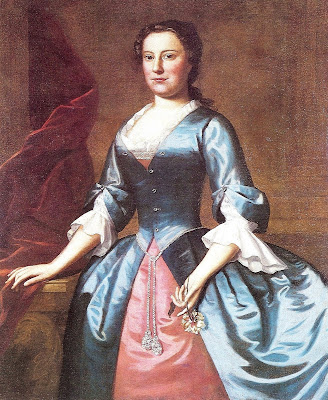+Anne+McCall+Philadelphia+Bayou+Bend+Houston+Mus+Fine+Arts.jpg) 1746 Robert Feke (American colonial era artist, 1707-1751). Anne McCall. Robert Feke was born on Long Island, New York. Little is known of his life until 1741, when he painted the Family of Isaac Royall. There are about 16 portraits known to be painted by Feke plus others argued to be by him. Feke worked in Boston, painting the families of wealthy merchants & landowners and seemed to disappear from the records about 1750.
1746 Robert Feke (American colonial era artist, 1707-1751). Anne McCall. Robert Feke was born on Long Island, New York. Little is known of his life until 1741, when he painted the Family of Isaac Royall. There are about 16 portraits known to be painted by Feke plus others argued to be by him. Feke worked in Boston, painting the families of wealthy merchants & landowners and seemed to disappear from the records about 1750.+Anne+Shippen+Mrs+Chales+Willing+1710-1791+Winterthur.jpg)
+Mary+McCall+(1725-1799)++Mrs+William+Plumstead+(Mayor+of+Phil)+Phil+Acad+of+Arts.jpg)
+Mrs.+Charles+Apthorp+Grizzell+Eastwick+Apthorp+++++San+Fran+Fine+Arts.jpg)
+Mrs+Isaac+Winslow++Brooklyn+Museum.jpg)


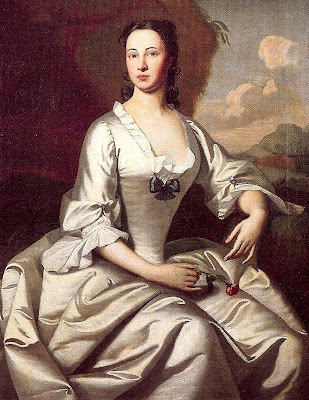.+Susannah+Faneuil+(Mrs.+James+Boutineau).+Nova+Scotia+Museum..jpg) 1748 Robert Feke (American colonial era artist, 1707-1751). Susannah Faneuil (Mrs. James Boutineau).
1748 Robert Feke (American colonial era artist, 1707-1751). Susannah Faneuil (Mrs. James Boutineau).+Portrait+of+a+Woman+Art+Insti+of+Chicago.jpg)
+Mrs+Joseph+Reade+Met.jpg)
+Mrs.+Henry+Bromfield+(Margaret+Fayerweather+MFA+(3).jpg)
+Margaret+Tudor+Nicholls+(Mrs.+Richard+Nicholls+Museum+of+Fine+Arts,+Houston,+Bayou+Bend.jpg)